Article prepared in collaboration with Getfluence
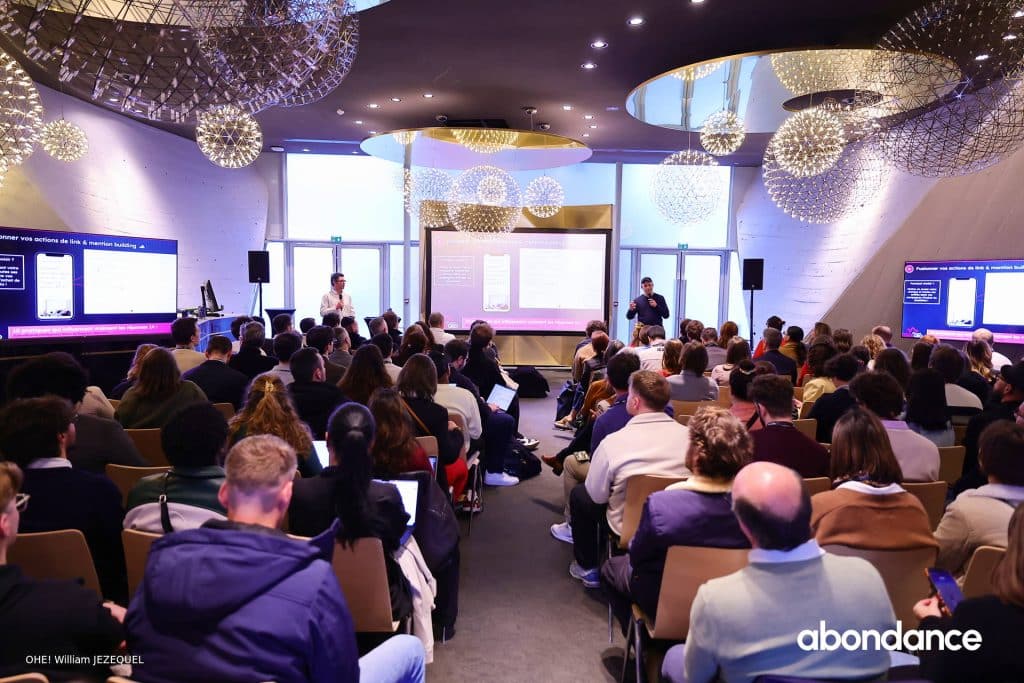
On March 20, 2026, Getfluence SEO/GEO consultant Julien Bismuth and Olivier de Segonzac, co-founder of Resoneo, held a 30-minute session at the SEO Summit. Their topics were: going beyond visibility in AI engines and taking action with concrete applications. Here is a detailed summary of their presentation!
Initial Observation: Being Visible Is No Longer Enough
2026. AI visibility reports are on the rise. However, connecting the dots between seeing your brand appear on ChatGPT or Gemini and understanding why it was chosen, as well as truly influencing the responses, is often challenging.
56% of AI response sources come from third-party content (press, editorial publications, reviews, forums, social media). The data obtained from 17.2 million quotes produced by ChatGPT, Gemini, Perplexity, and Claude in the fourth quarter of 2025 is quite striking: Only 44% of the quoted sources come from brand sites or blogs. The remaining portion, which is more than half, appears to come from third-party content perceived as neutral and reliable.
In other words: SEO is still indispensable, but it is no longer sufficient. To be selected by AI models, your brand must operate in the right places, where LLMs search for and select their sources.
How LLMs Work - An Important Reminder
Before moving on to applications, Julien and Olivier outlined a technical framework. LLMs do not reason: they calculate probabilities. When faced with a query, the model first decides whether to activate its web search capability:
- Without web activation: the response is based on the model's knowledge up to its cutoff date.
- With web activation: the model creates a pool of URL candidates (the grounding phase) and then selects and synthesizes.
The model makes selections based on probability calculations for the user. This is a mechanism, not intelligence. However, if you adapt to its operation, it is possible to influence.

10 Applications to Influence AI Responses
1. Identifying Questions with High Potential for the Brand
Traditional search volumes are no longer a reliable indicator for queries directed at AIs. The proposed method consists of three stages.
First, it is necessary to create Persona Searches based on existing keywords and positions: the profile, intentions, journeys, barriers, and opportunities of each target audience segment.
Next, by feeding these personas into ChatGPT, it is necessary to generate the decision-making, comparison, and commercial questions they are truly asking: the search for value, needs, shopping experience, decision-making assistance.
The final stage is to filter high-potential questions with three cumulative criteria:
- The brand name is not mentioned in AI responses
- The competitors' names are mentioned
- More than 25% continuity rate
2. Achieving the Best Position in Query Fan-Outs
When ChatGPT or Gemini activates its web search engine, it automatically generates derived queries (Query Fan-Outs). An important point to remember is: more than 50% of these fan-outs are formulated in English, even for a French-speaking user. Gemini, on the other hand, directly relies on the Google index.
Three concrete levers have been presented:
Fan-out Markers
Integrate typical terms of fan-outs into your content: best, top, highest, comparisons, reviews, 2026…
English Version of the Website
At least prepare the English versions of corporate content, bestsellers, and frequently asked questions (for example: corp.domain.com).
Meta Descriptions and URL Slugs
These elements are the components that the model primarily reads during the retrieval phase.
3. Identifying the Most Frequent Sources and Articles Related to the Topic
Domain Rating or authority indicators are no longer sufficient; neither in SEO nor in GEO in 2026. What is important is to identify the areas and source articles that AI models perceive as reliable on a specific topic.
The good news: Models provide a list of the sources they use to generate their responses. The problem is variability: To obtain a representative view, each question must be asked dozens of times to the target model.
This is where GEO methods with tools like Getfluence come into play (Spot Finder & Mentions feature), allowing you to influence AI responses by over 60%.
Be careful with the identification of sources via API; this may differ from the sources actually displayed in the platform's user interface.
4. Recognizing Good and Excellent Points Compatible with LLM
Once the sources are identified, they need to be qualified. The method involves analyzing two complementary dimensions:
- Quote frequency: how often this area or article appears in test prompts.
- The sentiment of the sources: is your brand's (and your competitors') name mentioned positively, neutrally, or negatively in these contents?
The tools provided allow you to filter sources that remind you of competitors but do not mention your brand. These are priority targets for placement or relinking actions.
5. Creating URL Ambassador and URL Review
One of the strongest strategies presented in the session: the relinking strategy creates a triple impact simultaneously.
- Source URL: First, identify press articles, product tests, expert reviews, or comparative guides that positively mention your brand.
- Relinking: Publish new content that quotes the source article and create backlinks to this URL (guest posts, co-authored articles, press releases).
Result obtained: Triple impact
- SEO: better ranking of the source URL
- E-reputation: increase in positive quotes
- GEO: increased likelihood of LLM quoting
As summarized by the two experts: links feed Google. Quotes feed LLMs. With a single piece of relinking content, you can achieve two targets simultaneously.

6. Strengthening Trust and Freshness from Within (E-E-A-T Signals)
Google has 27 years of experience in evaluating content quality. ChatGPT has been around for 3 years and has quickly grasped the importance of learning from its big brother. E-E-A-T (Experience, Expertise, Authority, Trust) signals have now been integrated into the ways models evaluate sources. Page 27 of the Google Search Quality Evaluator Guidelines (September 2025 update) is clear: Trust is the most important member of the E-E-A-T family.
7. Accepting Neutrality to Stand Out
This point has been one of the least intuitive explanations of the session. In March 2026, perceived neutrality has become an increasingly decisive selection criterion for models; this criterion was assessed as less central six months ago.
The logic is simple: an LLM must be able to compare several options to generate a reliable response. Content that mentions only one brand or solution is perceived as promotional and models do not prefer this as a primary source.
| ❌ Single brand content is perceived as promotional by models. AIs prefer guides, documents, and instructional articles. They avoid advertising and biased comparisons. | ✅ Multi-brand content (AI-First™ format) LLMs love pages with lists, comparisons, and tool rankings. An article that mentions multiple solutions significantly increases the likelihood score for quoting. |
A real test has been presented: The AI-First™ article published by Getfluence in February 2026 compared six electronic signature software on monimmeuble.com. Pre-campaign results: The customer brand (Oodrive) had no quotes or references in responses. Post-campaign results: The brand ranked first among the recommended solutions and the article was cited as a source.
8. Combine Your Link Building and Quotation Generation Actions
Why are you separating SEO netlinking campaigns and brand citation GEO actions when a single piece of content can achieve both goals?
The suggestion is simple: Ensure that your brand and all its assets (products, managers, certifications, use cases…) are systematically mentioned in all your backlink acquisition campaigns. An article about interior decoration for an e-commerce site can mention the brand while also generating an SEO signal and appearing as a source in an AI response about the topic.
An example presented is a response from ChatGPT about decorating a living room with a velvet sofa; it directly quotes an article from Frenchyfancy, which has editorially integrated the customer's brand into the topic.
9. Produce an Up-to-Date Format and Ensure the Door Is Open
A frequently overlooked but decisive application: AI crawlers must be able to access your content. If your robots.txt file blocks LLM crawlers, no content, no matter how optimized, can be used to generate responses.
The main bots that should not be blocked are listed:
- ChatGPT / OpenAI: OAI-SearchBot (real-time search bot), GPTBot (training bot)
- Google / Gemini: Googlebot, Google-Extended
- Claude / Anthropic: Claude-SearchBot, Claude-User (note: Claude-Web is no longer available)
- Perplexity: Perplexitybot, Perplexity-User
The Getfluence platform has integrated an IA accessibility module that automatically analyzes the robots.txt file of each domain and reports partial or complete blocks by LLMs; this provides significant time savings for auditing your shared site portfolio.
10. Providing New Information - Knowledge Gain
The last point may be the most strategic in the long term. Julien and Olivier introduced a Google patent (US12013887B2, granted in June 2024) that assigns a Knowledge Gain score between 0 and 1 to each piece of content; this score measures the amount of truly new information.
| Score → 0: general content A rewrite of what already exists (best of 2026, general comparisons…), even if produced by AI. The model has seen this information dozens of times. | Score → 1: new information Proprietary studies, internal test data, quotes from field experts, verified trial results, first-hand customer references. |
Remember that if an LLM has seen information 50 times, it will not quote it for the 51st time. In other words: Provide information that others cannot say.
On product pages, this principle means filling a gap: brands list technical specifications, but users define situations and limitations. The LLM selects its sources in this gap. Two concrete actions have been proposed:
- On list pages (PLP): create situational surfaces based on real uses ("Passes through metro gates", "Scratch-resistant", "Compatible with glasses").
- On product pages (PDP): add situational paragraphs and FAQs from customer reviews, customer service, and forums; contextual layers that enable the LLM to recommend a specific product.
Key Takeaways
During this presentation, Julien Bismuth and Olivier de Segonzac succeeded in creating a clear methodological framework for moving from measurement to action in GEO. The fundamental logic: AI models are probability machines. We can influence these probabilities by simultaneously affecting the quality of the contents and perceived reliability, the presence in LLM-compatible third-party sources, and the neutrality required by AI models.
The main theme of the session is that SEO and GEO do not oppose each other; they reinforce each other when the right formats and distribution strategies are adopted. The AI-First™ format developed by Getfluence represents this combination: It is structured to respond to the selection criteria of AI engines while also adhering to editorial standards that ensure the contents are reliable and linkable.
In 2026, being visible is no longer enough. You need to be selected.
























Comments
(3 Comments)