Metehan Yesilyurt's SDK analysis revealed the names of the internal pipelines of Google Discover. Our data shows what each one does: volume, reach, timing, leading areas. 42 million cards, hundreds of devices, three months of observation.
What We Did
For three months (December 2025 - February 2026), we observed the real Discover streams of hundreds of devices. Result: 42 million cards were analyzed. We associated each card with the pipeline responsible for its selection.
The names were already available in the Google SDK, recently published by Metehan Yesilyurt. What was missing was what they actually did in practice: how much content each selected, how many devices it was shown to, at what speed it operated, and which areas it prioritized. Our data reveals this.
We calculate four metrics for each pipeline:
- Reach: percentage of devices that see each URL
- Speed: average age of articles at the time of emergence
- Feature: percentage of URLs specific to the pipeline
- Volume: share within the total stream
Explanation: Not an algorithm, but a layered system
Common belief: Discover uses a recommendation algorithm. Reality: this is a system consisting of six functional layers, each with its own logic and target audience.
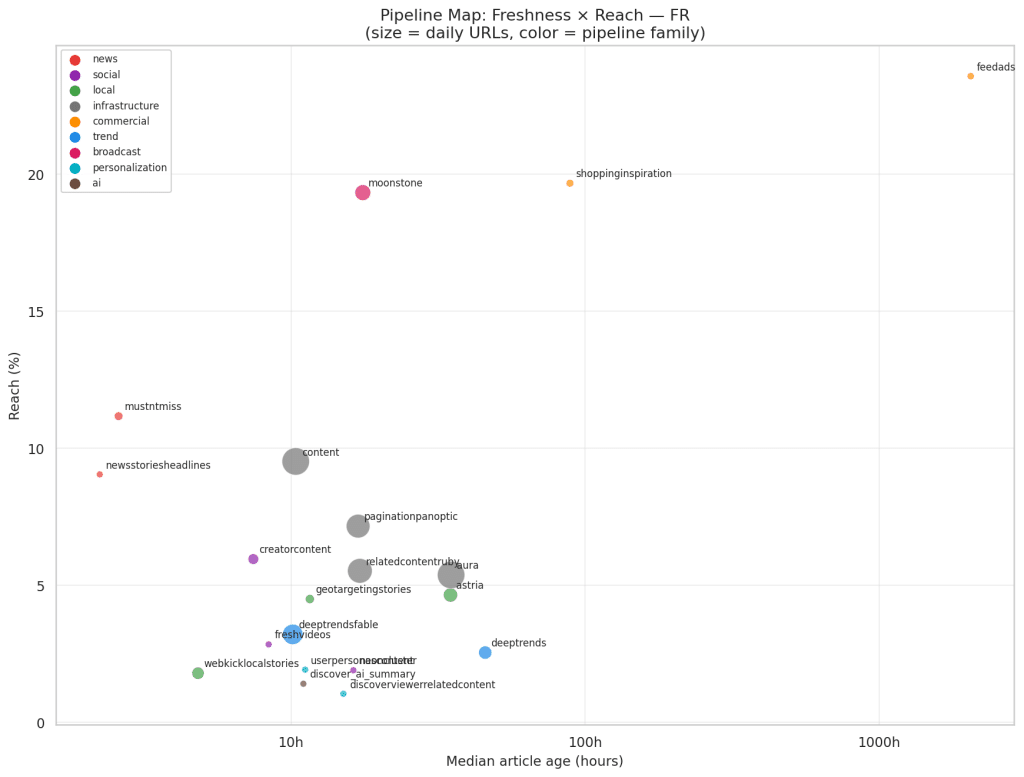
Each pipeline is positioned with speed (X axis, log) and reach (Y axis). Color = functional family. moonstone and shoppinginspiration stand out in reach; mustntmiss and newsstoriesheadlines are the fastest; deeptrends and aura stay the longest.
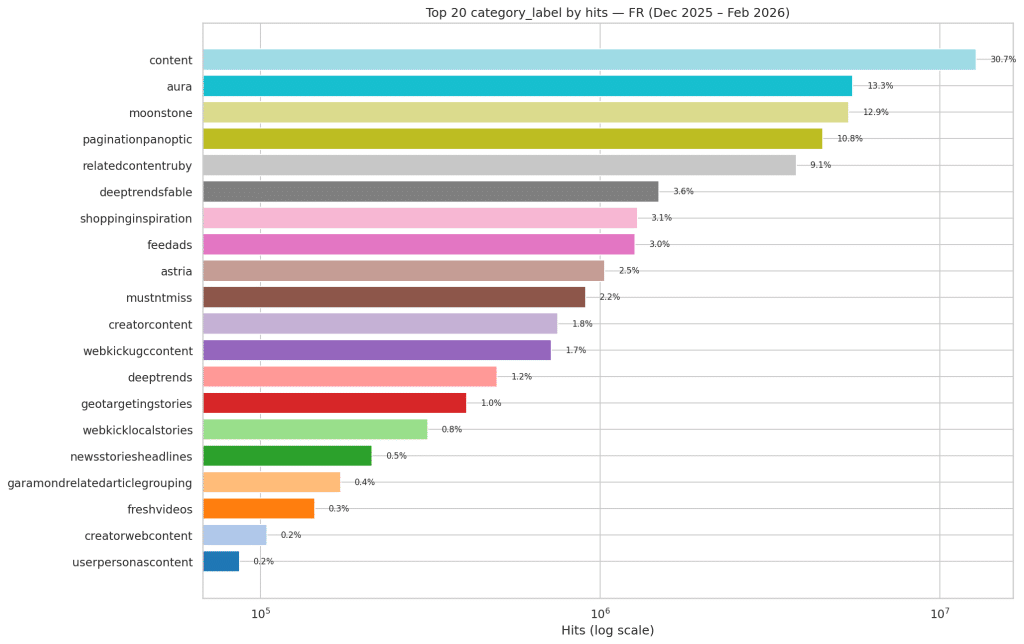
20 FR pipelines ranked by total volume. content is leading at 30.7%, followed by aura (13.3%) and moonstone (12.9%).
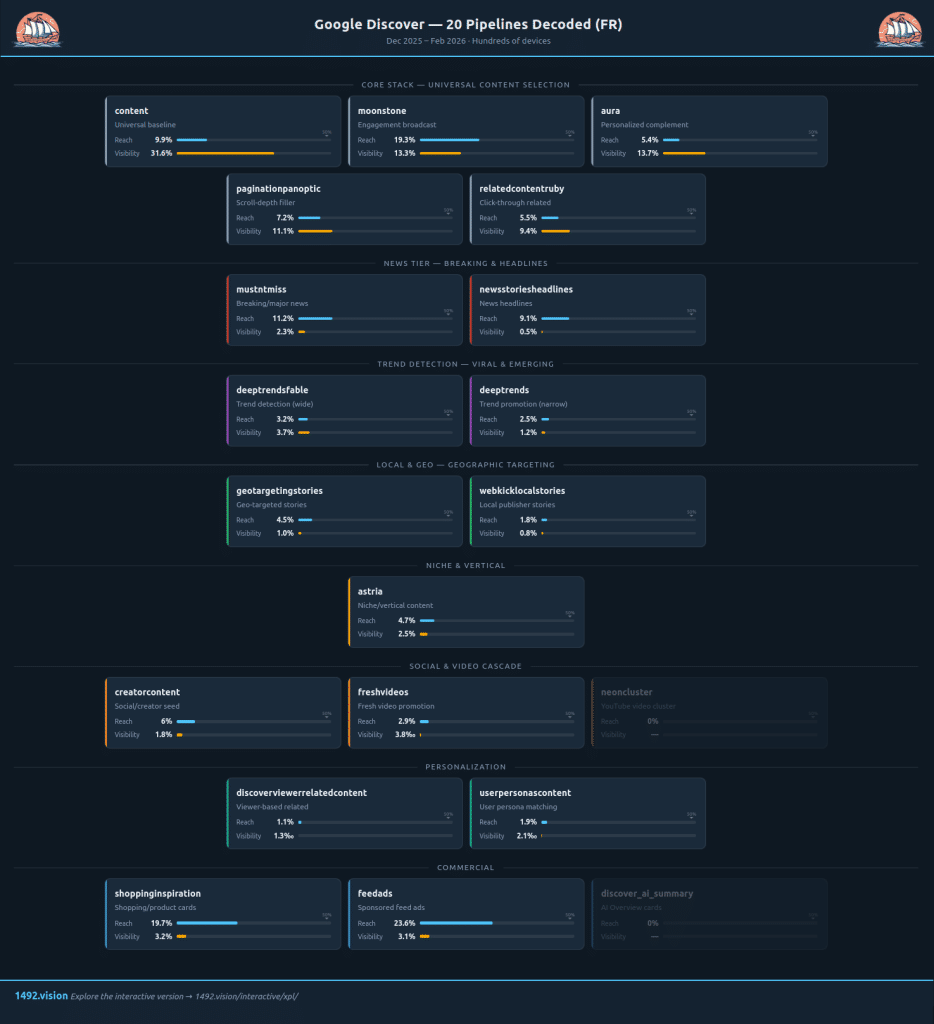
Map of main pipelines for FR and key metrics
Six layers:
- Content base: content, moonstone, aura, paginationpanoptic, relatedcontentruby. Core loop: content enters through content, if interaction continues it is amplified by moonstone, diversified with aura, and extended with scroll (pagpan) and click (ruby).
- News and urgency: mustntmiss (priority boost ~2x, Le Monde leads) and newsstoriesheadlines (Google News clusters, 46% specific URLs).
- Trends: deeptrendsfable detects, deeptrends stays. Sequential pipeline: 27% transition rate, 21 hours delay. x.com is a source of trends in FR.
- Local and geographic: geotargetingstories (mainstream geographically filtered), webkicklocalstories (completely hyper-local, 67% specific URLs, local press), astria (local authority, 1.5 days delay).
- Social and video: creatorcontent (leading in x.com FR at 75%, not YouTube), freshvideos, neoncluster (not in FR). Video streams primarily operate in English.
- Commercial: shoppinginspiration (19.7% reach, 3.7 days lifespan) and feedads (pure advertising, 24% reach).
Message: Optimizing for "Discover" without understanding the pipelines is like optimizing for "Google" without understanding the difference between Search, News, and Shopping. Each pipeline has its own logic and each is a separate lever.
Four numbers that change everything
Moonstone shows each article to 1 in 5 devices
Reach: 19.3%. This is 2 times that of content (9.9%). Moonstone does not select a lot of articles, but the ones it selects are shown to the maximum number of devices. This is a deliberate publishing strategy.
Featured content: horoscope (3.5x), betting/gaming (3.3x), entertainment, weather, celebrities. Still, the regional newspaper Ouest-France leads in moonstone. The secret: a national angle on a local event, weather, regional celebrities.
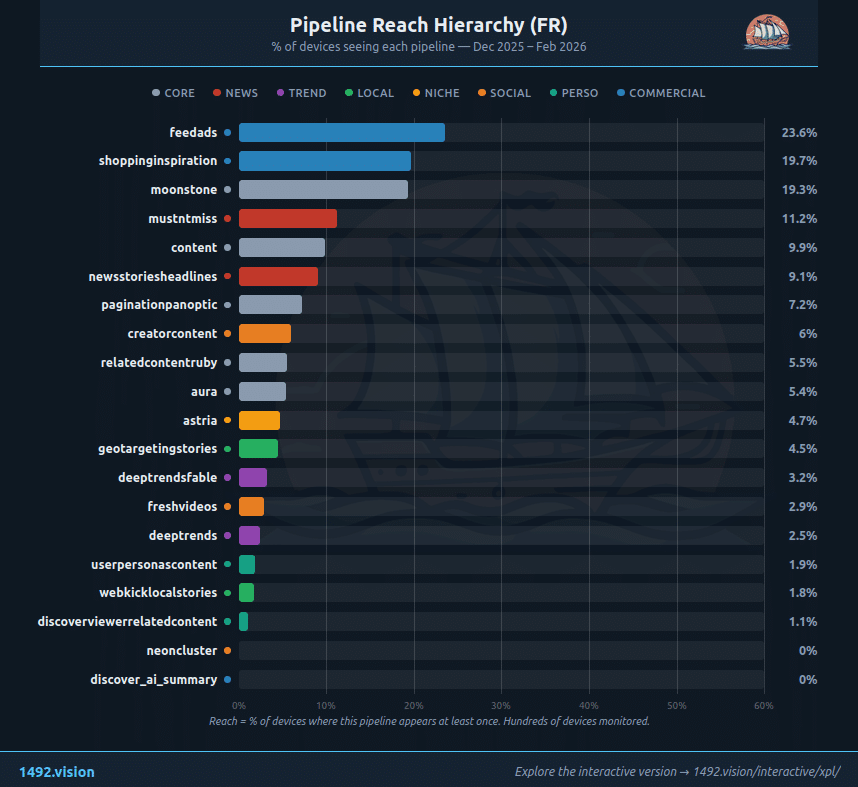
Access rates for each pipeline in FR (% affected devices). moonstone and shoppinginspiration lead, access is not proportional to volume.
A product article lives 8 times longer than a news article
shoppinginspiration: 3.7 days average lifespan. content: 0.47 days (11 hours). A product test published on Monday is still visible on Discover on Friday. This is an extraordinary visibility window, but the shopping pipeline is a silo. Low simultaneity with other pipelines. An article does not easily exit the product silo.
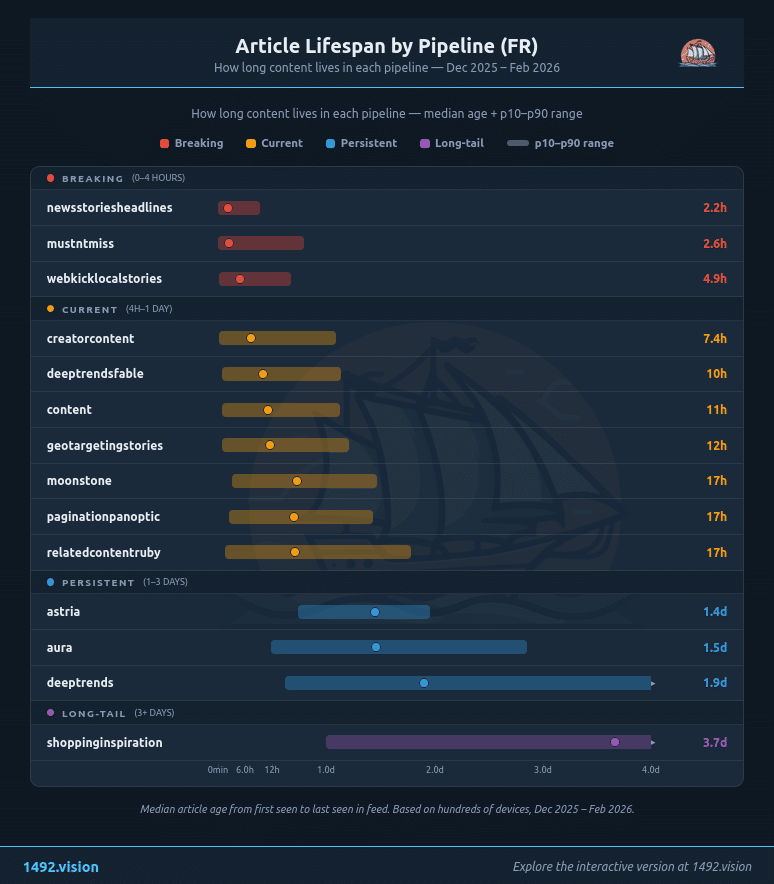
Between newsstoriesheadlines (2.2 hours) and shoppinginspiration (3.7 days). Product content lives 8 times longer than news.
58% of URLs in FR appear in 2 or more pipelines
This is the most actionable finding. Most French articles in Discover are not limited to a single pipeline; they traverse the system.
- 42% of URLs in a single pipeline (usually content)
- 20% in two pipelines
- 13% in three pipelines
- 25% in four or more, with some endpoints reaching 12-14 pipelines
Each additional pipeline = additional visibility window, partially with a different target audience and timing. An article in content + moonstone + mustntmiss = three times the chance of visibility.
Multi-pipeline mechanisms, leverage per profile, the complete scorecard analysis will be featured in an upcoming special article.
The system is constantly evolving
What we have shown is a snapshot. Google regularly adds and removes pipelines. A family entirely, queryrecommendations*, has been abandoned: the old system worked based on queries, the new one works with embedding and interaction signals. We are observing about 8 new identities that have not yet been included in our analysis (collaboration filtering, NL tuning, entertainment snippets, garamond/Google Showcase).
The direction is clear: from query-based to embedding direction, from text to social/video direction, transitioning from passive selection to real-time interaction.
Three profiles, three strategies
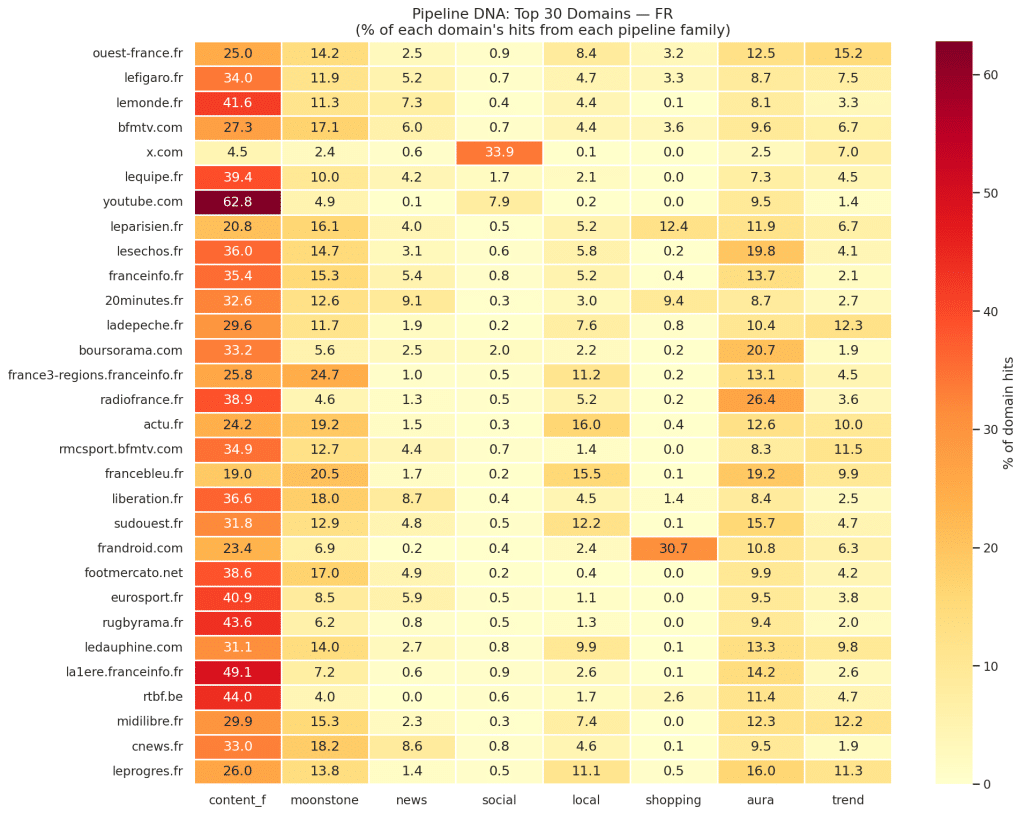
Each row = a field, each column = a pipeline family, color = hit percentage. Find your field or your clients' field and see the pipeline effect.
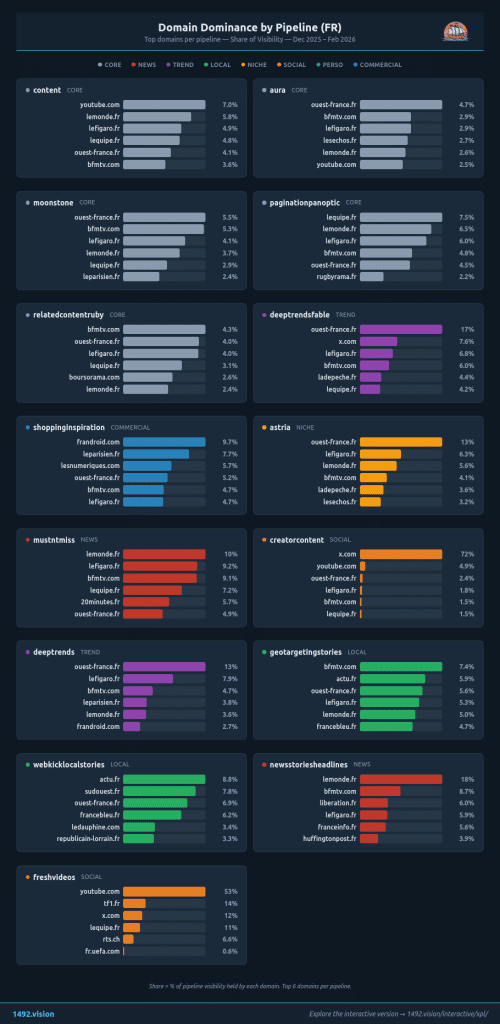
For each pipeline, 5 leading fields and their shares. The heat map lacks details on where who is leading and with what weight.
National Press (Le Monde / Le Figaro Profile)
Presence in 8-10 pipelines. Le Monde leads in mustntmiss (11.3% of the pipeline) - priority boost ~2x, rewarding editorial importance. Goal: maximize transition in moonstone (interaction) and mustntmiss (importance), these two amplifiers.
Regional Press (Ouest-France / La Dépêche Profile)
webkicklocalstories are the only pipelines with 67% URLs not found elsewhere. However, Ouest-France is not limited to local: #1 in moonstone, in the top 5 in geotargetingstories, deeptrendsfable, astria. Spread is extraordinary: content 25%, moonstone 14%, local 8.4%, aura 12.5%, trends 15.2. Goal: multiply pipelines by combining local and national angles.
Technology / Review Site (Frandroid / Les Numériques Profile)
shoppinginspiration offers significant reach (19.7%) and 3.7 days lifespan. However, shopping is a silo - very low simultaneity with other pipelines. A Samsung Galaxy test stays in shopping. Goal: to reach content + aura without being limited to product testing (2 times more representation in technology/science). Adding an editorial angle (trend analysis, market context) could open doors.
Full recommendations for national, regional, technology, lifestyle, video, pure player, and finance profiles will be detailed in our Substack series.
Discover for Yourself
These results are a preview. Full analysis, 20 pipelines, data per pipeline, leading fields, typical titles are accessible:
- Interactive discovery tool: navigating through 20 pipelines, comparing metrics, seeing leading fields and typical titles
- Substack series: in-depth review of a group of pipelines each week, data, graphs, and recommendations
- Reference analysis: 1492.Vision/research/ - complete reference articles with details per pipeline, in French and English.
The Discover system is evolving. These data represent a snapshot between December 2025 and February 2026. Pipelines that are exploding today did not exist three months ago. Therefore, tracking the evolution is essential, not just to capture a moment in time.
Data: 42 million Discover cards, December 2025 - February 2026. Analysis: 1492.vision. Thanks to Metehan Yesilyurt for the SDK analysis, our data shows what each pipeline is doing in practice.





























Comments
(5 Comments)