
A question spoken in all languages: How to become visible in LLMs (ChatGPT, Gemini...)?
Here, we will try to provide very concrete advice and present an example outcome.
SEO is undergoing a deep transformation, and this is not the first time.
John Mueller emphasizes on seoclaims.com (the source of Google's statements) that companies should rely on their own data analyses rather than trends like GEO to assess the real impact of AI on traffic. Indeed, these are still new acquisition sources that require expertise.
For years, the goal has been clear: to be among Google's top results. To be in a good position, to get clicks, to generate traffic.
However, Google is not the only channel; ChatGPT is on everyone's lips: We want Generative Engine Optimization (GEO) or in other words, "I want my brand to be mentioned in ChatGPT".
"I want my brand to be mentioned in ChatGPT".
This is possible, but it is worth noting that as of July 2025, ChatGPT has over 700 million active users weekly and receives about 2.5 billion queries daily. GPT states that approximately 70% of uses occur outside of professional contexts.
In summary, this situation confirms the importance of AI in daily life, but it also emphasizes the necessity of maintaining a critical mindset.
With the emergence of LLMs like ChatGPT, Perplexity, or Google's AI General Views, the user is no longer searching for a list of results. They expect a direct, concise, and ready-to-use answer.
At Uplix, we have the chance to have a perspective on techniques that really work.
From Search Engine to Answer Engine?
Historically, Google functioned as a tool. It offered:
- Many links
- Many sources
- Many comments
The user was the decision-maker.
With LLMs, this logic is slowly evolving. The interface is changing:
- A question
- A single answer (or almost single)
- Sometimes a few secondary sources
But most importantly, an implicit choice is made by AI.
The user no longer chooses; the model decides.
This expresses a very simple thing: If you are not in the answer, you cannot exist.
How Does LLM Work? (Simplified but Useful Version)
To understand how you will appear in ChatGPT, you need to understand how it "thinks".
An LLM does not work like a classic search engine; it does not search for the "best page".
It does the following:
- Predicts a sequence of words
- Relies on probabilities
- Utilizes learned information
- Enriches with external sources if necessary (RAG - Retrieval Augmented Generation)
Its goal is not absolute reality. The aim is to generate the most likely answer in a specific context.
And this changes everything, because to be mentioned, you must have:
- Possibility
- Reliability
- Consistency with the question
Simply being well-ranked is not enough.
What Are the 3 Key Levers to Appear in ChatGPT?
Looking back and conducting concrete tests, we can structure things around three key levers. These are not theories; they are field observations.
1- Being Included in Training Data
This is the most intuitive lever and often the first that comes to mind.
LLMs are trained on massive volumes of data: web pages, articles, documents, publicly available content.
Therefore, historically, the most visible brands have a better chance of being recognized by the model.
Thus, some companies naturally stand out:
- Big brands
- Historical players
- Market leaders
However, one must be realistic. This lever has two major limitations:
Firstly, choosing to be included in a Dataset is very difficult.
Secondly, its activation is slow. Building sufficient recognition can take a long time.
The result: "being recognized" is helpful, but it certainly does not guarantee being mentioned!
Today, while many recognized brands have little presence in the answers, some smaller brands manage to stand out.
2- Being a Citable Source!
This is the most operational leverage today.
LLMs base their responses on existing content, especially when they use retrieval-augmented generation (RAG).
But beware: not all content is equal. What we observe very clearly is this:
- Structured content performs better
- Direct answers are preferred
- Educational content is overrepresented
- FAQ or "guide" formats are very effective
In other words, it is not enough to produce content; it is necessary to produce "citable" content.
A citable content should include:
- Clear
- Well-structured
- Directly usable by an AI
- Consistent with a specific intent
The logic we are in is exactly this:
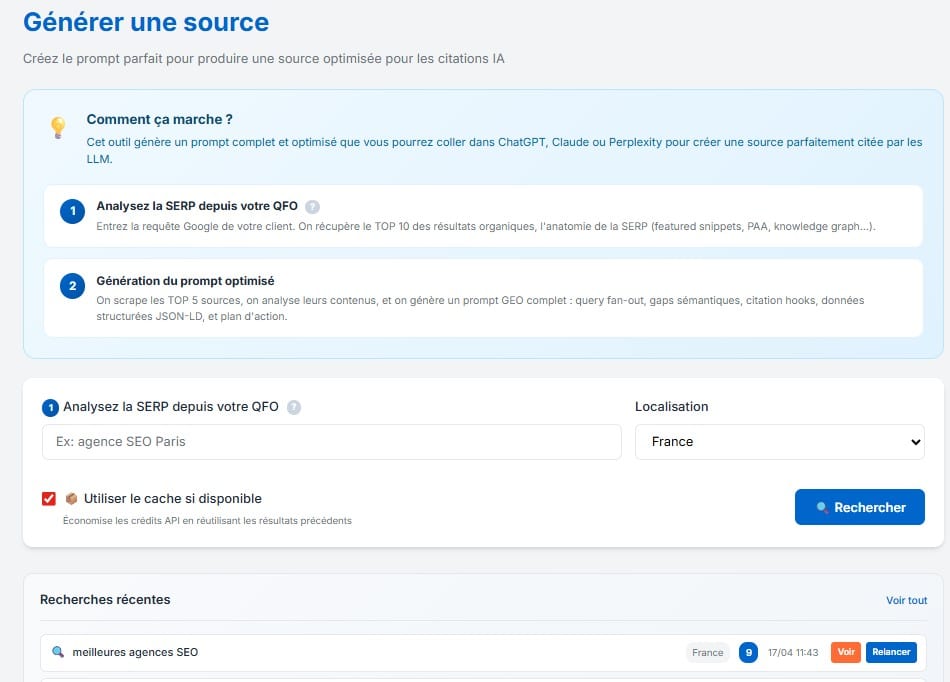
Our goal is no longer just to look good to Google, but to be a piece of response for LLMs.
This tool works with the logic of better reproducing what LLMs do.
It deeply analyzes Google's SERP with a strategic query (QFO - Query Fan Out). It tries to understand what Google evaluates as the "best answer" by understanding not only the organic TOP 10 but also its entire structure (Featured Snippets, PAA - People Also Ask, Knowledge Graph).
Then, it goes further: it scans the content of the best sources, identifies dominant angles, semantic gaps, and differentiation opportunities.
Based on this foundation, it prepares a GEO prompt that will necessitate citation: Query Fan-Out covers all intents, creates citation hooks for LLMs to retrieve the source, enriches with structured data (JSON-LD), and establishes a clear action plan.
Result: We are not just producing content; we are "producing" a source calibrated to be used and cited by AIs.
3. Semantic Alignment
Today, it is probably the strongest leverage. And paradoxically, it is the least understood.
An LLM works with vector representations. It brings together concepts, entities, contexts. When a user asks a question, the model activates a network of relationships.
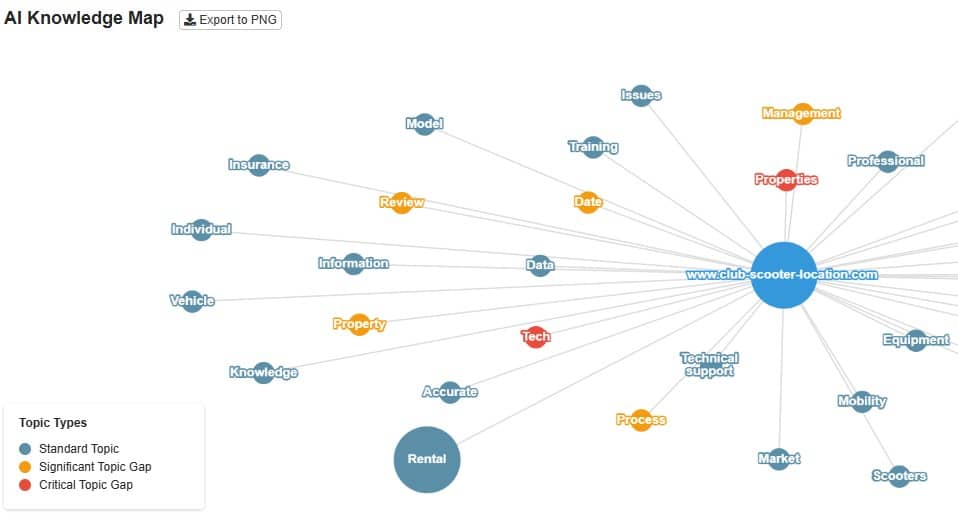
And some brands are part of this network. Others are not. This is where everything takes shape.
If your brand is not associated with the right concepts, you will never appear, even with good content.
From Theory to Practice: Concrete Tests
Our example of "the best SEO consultants" is working, Uplix is in the top 3 on Google.
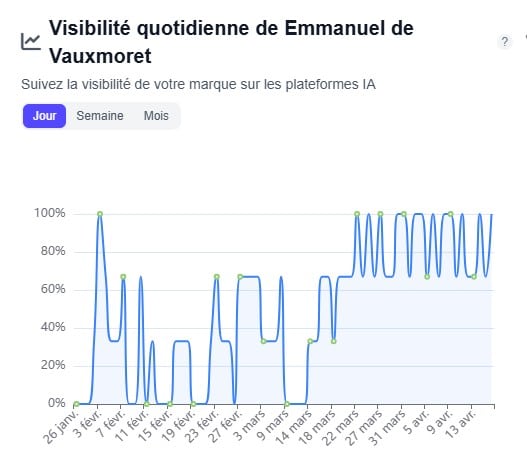
I tested this recipe with prompts like "Give me the top 5 SEO consultants" or "Top 5 SEO consultants" on my personal site edv.fr, and the results are definitive (external tracking tool: meteoria here)
Let's take another simple example:
“Which is the best SEO agency?”
The model will generate a response based on:
- Semantic relationships
- Brands already associated with this concept
- Trust signals
If your brand is not in this semantic field: it cannot exist for the model.
This is how waikay.io works: this tool now works not only with keywords but with relationships.
Goal: To connect your brand with the right queries in the model's mind.
And this works because for this prompt example, Uplix is in the top 3 on Google.
A Frequently Overlooked Leverage: Authority
There is a point that many people overlook. Even in a world dominated by LLMs, the concept of authority holds central importance.
The chance of a brand to appear in answers is if:
- It is being cited
- It is being mentioned
- It is being shared
- It is being recommended
Why? Because these signals increase its perceived credibility.
How? This happens through the leverages we already know very well in SEO:
- Netlinking
- Public relations
- Media presence
- External citations
Classic methods are not disappearing. On the contrary, they serve to create a solid foundation because LLMs need to pass through search engines!
Therefore, the SEO of your site will have a significant impact on your presence in LLMs, especially through the Query Fan Out research that LLMs do to rank the validity of results.
Concrete Observations Related to Authority
In the field, the differences are striking. Some brands are systematically quoted many times in strategic queries, while others are not. The difference is not only in authority but also appears in:
- Structure of the content
- Quoting capacity
- Semantic coherence
- Presence in the ecosystem
Many companies still approach LLMs with classic SEO logic. This is a mistake.
The main mistakes we have observed:
- Producing generic content that does not offer unique value
- Writing for Google, not for AI responses
- Ignoring the real queries of users
- Not working on assets and relationships
Conclusion: There is no impact on the responses produced.
The Impact of the “Bigfoot Effect”
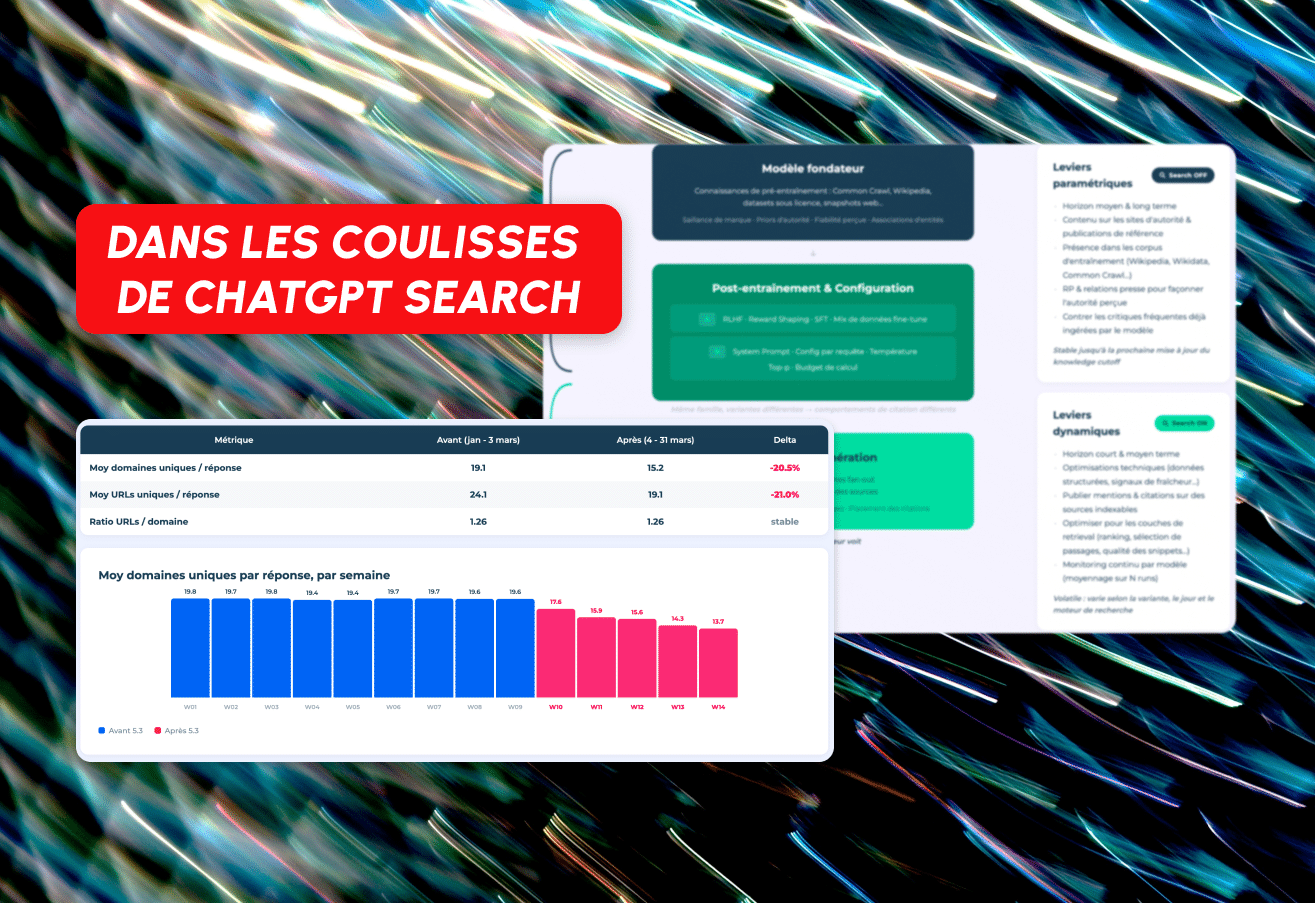
The Bigfoot effect refers to the tendency of AIs (like ChatGPT Search) to greatly support a few websites with very high authority, thus reducing source diversity.
The visibility space generated by AI has significantly narrowed. Web giants are making it much harder for other sites to gain visibility by drawing all the attention of LLMs.
Therefore, we have launched a special offer to enhance your presence on Reddit, Wikipedia, and other web giants!
Final Word?
Brands that are visible today will capture an increasing share of demand. This is a train that needs to be boarded quickly for a voice share that is still low but developing!
As in SEO, we now want not just to be visible, but to be chosen and converted. This requires:
- A new understanding of models
- A new way of producing content
- A more comprehensive strategy
We have established complex processes to achieve concrete results, but the logics are the same as those valid for SEO: technical, semantic, and authority. For more information, visit our website: https://www.uplix.fr/agence-geo-ia/ (No-obligation needs analysis)




















Comments
(4 Comments)