By 2025, one in two French people will have used artificial intelligence. However, adoption in the business world is still cautious, with uses generally being simple and training almost non-existent. A large Ipsos BVA study conducted for Google provides a comprehensive assessment of the situation and identifies the elements necessary for acceleration.
Highlights:
- The use of artificial intelligence has doubled in France over two years, but only 9% use it daily at work.
- 70% of executives believe that artificial intelligence increases their companies' efficiency, but employees do not yet share this view.
- Small businesses are structurally experiencing significant delays, but their managers use artificial intelligence more creatively than the average employee.
- Only 21% have received training in artificial intelligence at work; receiving training increases usage frequency by 2.6 times.
Adoption is Accelerating, but Understanding is Still Limited
France has somewhat reversed its overall use of artificial intelligence. The number of users has nearly doubled in two years.
| Year | Artificial Intelligence Users in France | World Average (20 Countries) |
| 2023 | 28% | 38% |
| 2024 | 35% | 44% |
| 2025 | 51% | 62% |
France ranks ahead of the US (40%), Japan (42%), and Germany (47%), but falls behind the UK (56%), Italy (59%), or Spain (64%).
Using artificial intelligence does not mean understanding it. At this point, the French face more challenges: 59% state that they understand what artificial intelligence is well, while this rate is 66% in the US, 64% in the UK, and 75% in the Netherlands. The research offers a cultural explanation: in France, artificial intelligence is addressed more in terms of regulation rather than concrete uses.
Differences in understanding also show significant changes based on profiles:
| Profile | Good Understanding of Artificial Intelligence |
| Men | 67% |
| Women | 51% |
| Under 35 | 72% |
| 50 and older | 45% |
| University Graduates (Bachelor's and above) | 66% |
| Non-University Graduates | 51% |
These differences are not insignificant: they become even more pronounced in professional uses.
A Contradictory Perception: Good for the Economy, Worrisome for Society
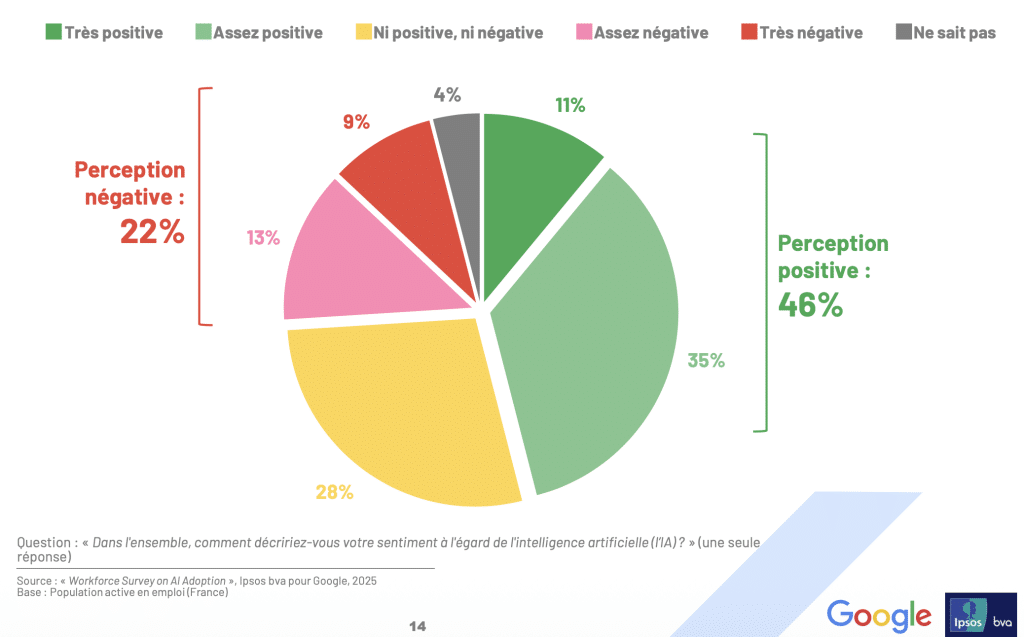
The image of artificial intelligence has improved. One in two employees (46%) now has a positive perception, while only 22% show a negative attitude.
However, the perception remains fundamentally contradictory. Employees see artificial intelligence as an opportunity for companies (41%) and a personal opportunity for themselves (37%). However, they are much more skeptical about its societal impact:
| Impact of Artificial Intelligence... | Opportunity | Threat |
| Companies | 41% | 22% |
| Personally | 37% | 24% |
| Country Economy | 31% | 28% |
| Employees | 28% | 34% |
| French Society | 25% | 37% |
| Environment | 23% | 37% |
When asked about potential disadvantages, employees first mention over-dependence (25%), followed by loss of human interactions (24%); data privacy risks (23%) or fears of displacement by artificial intelligence (21%) are ahead. The fear of technological unemployment is not the main driver of resistance.
Executives are Definitely Convinced
The executive segment has a completely different view. When asked about the factors that will have the most positive impact on their organizations in the next five years, 53% cite advancements in artificial intelligence as the top factor, well ahead of ecological transition (28%) or enhancing employees' skills (23%).
This enthusiasm is based on concrete results:
- 70% believe that artificial intelligence increases their companies' efficiency.
- 52% state that employees save more than 3 hours a week.
- 76% redirected this freed-up time to more valuable tasks.
- 64% trained their employees on new skills.
- 57% increased their employees' salaries after implementing artificial intelligence applications.
- 75% hired new employees to support this application.
Far from the image of a technology that will lead to job loss, executives are not very worried: only 5% consider reducing the number of employees in the event of transferring positions to artificial intelligence. And 80% see it likely that their companies will use these tools more in the coming year.
Uses in Teams Remain Very Cautious
Despite this top-level optimism, actual uses within teams continue to be limited.
| Frequency of Artificial Intelligence Use | At Work | In Personal Life |
| At least once a week | 35% | 41% |
| Every day | 9% | 10% |
| Never | 37% | 25% |
Among those using artificial intelligence at work, tasks mostly remain simple:
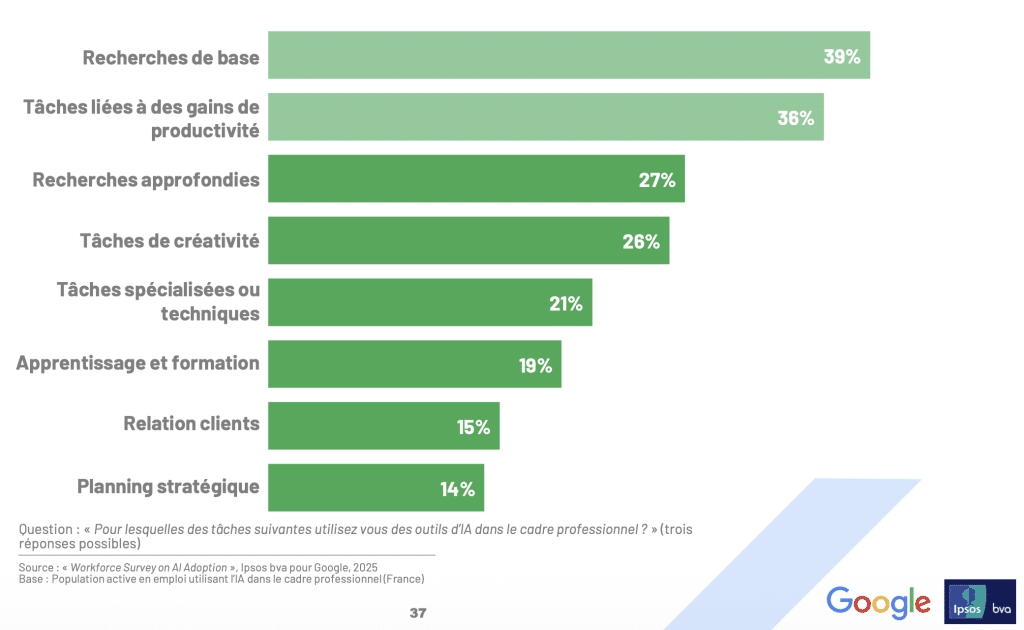
More advanced uses are generally carried out by younger individuals. Among those under 25, 30% use artificial intelligence for creativity, 26% for education, and 23% for technical tasks; these rates are 24%, 13%, and 13%, respectively, in the 55-64 age group.
So why are these uses remaining so limited? The main barrier is simple: 27% think that artificial intelligence is not suitable for their tasks. The next reasons are lack of interest (19%), doubts about the quality of results (15%), and difficulty integrating into work processes (13%). Thus, not knowing the potential of the tool is the real barrier; much more than technical or ethical concerns.
“Shadow Artificial Intelligence”: A Sign of Real Interest
An interesting phenomenon emerges from the research: “Shadow Artificial Intelligence.”
42% of employees using artificial intelligence at work access it mostly through their personal accounts; only 29% use a professional account provided by their employers. And only 14% state that their companies have established an internal policy regulating this use.
The executive segment is aware of this: 35% have observed that employees use their personal accounts for professional purposes, and 37% indicate that employees started using the tool before a formal framework was established.
This phenomenon poses a risk in terms of data privacy. However, it primarily reflects employees' desire to explore the potential of these tools; this happens without encouragement or training. Employers need to take this into account.
Small Businesses and Freelancers: Structurally Behind, but Pioneers in Use
Small businesses represent more than 99% of French companies and more than a third of private employment. This lag is a critical issue for the country's transition to artificial intelligence.
| Company Size | Monthly Artificial Intelligence Adoption Rate |
| Large Companies (250+ employees) | 58% |
| Medium-Sized Companies | 31% |
| Small Companies | 15% |
Still, individually, managers of small businesses are in a better position regarding usage frequency and quality than the average employee.
| Profile | Frequent Use (a few times a week) | Use for Creative Tasks |
| Small Business Managers | 35% | 35% |
| Freelancers | 31% | 37% |
| Employees (general) | 25% | 24% |
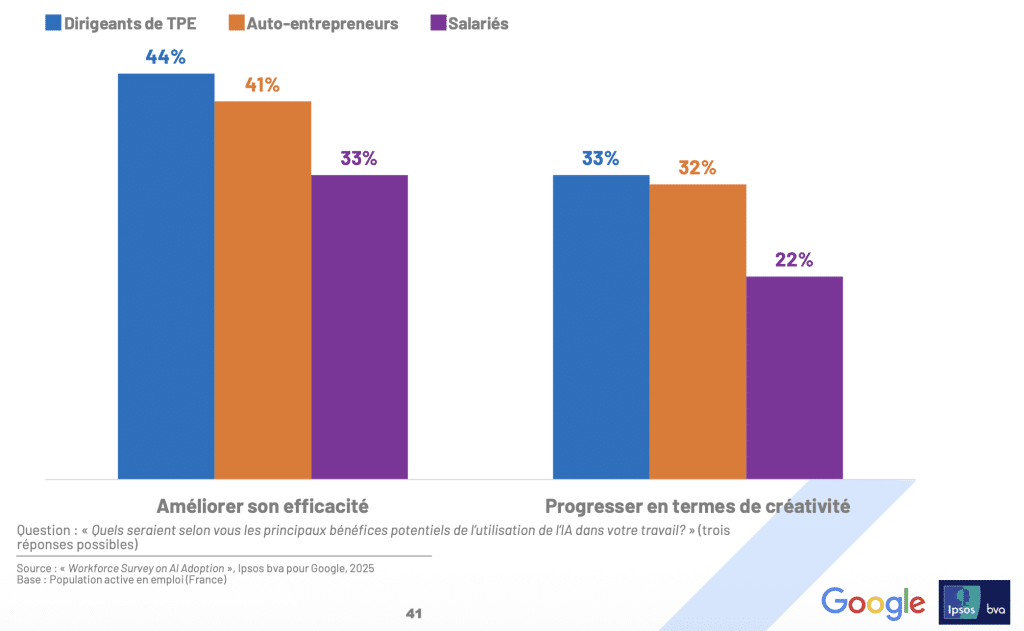
Moreover, they are more convinced of the benefits: 44% of small business managers and 41% of freelancers believe that artificial intelligence can enhance their productivity; this rate is 33% among employees. The difference in creativity is also quite pronounced (33% and 32%, compared to 22%).
These profiles have generally discovered artificial intelligence through self-learning and turned it into a concrete commercial development tool: brand identity creation, cost calculation, strategic planning. However, in some sectors, such as crafts, restaurants, and manual labor, it is difficult to see the connection between artificial intelligence and daily operations.
Training: The Strongest and Least Used Tool
Data related to training is among the most striking findings of the research.
| Profile | Rate of Artificial Intelligence Training |
| Large Companies (ETI/GE) | 30% |
| Medium-Sized Companies | 19% |
| Small Businesses (less than 10 employees) | 16% |
| Freelancers | 13% |
| All Employees | 21% |
However, the impact of training is significant. Employees who receive training have a rate of using artificial intelligence at least once a week of 68%, while this rate is only 26% for those who do not receive training. This is a difference of 1 to 2.6.
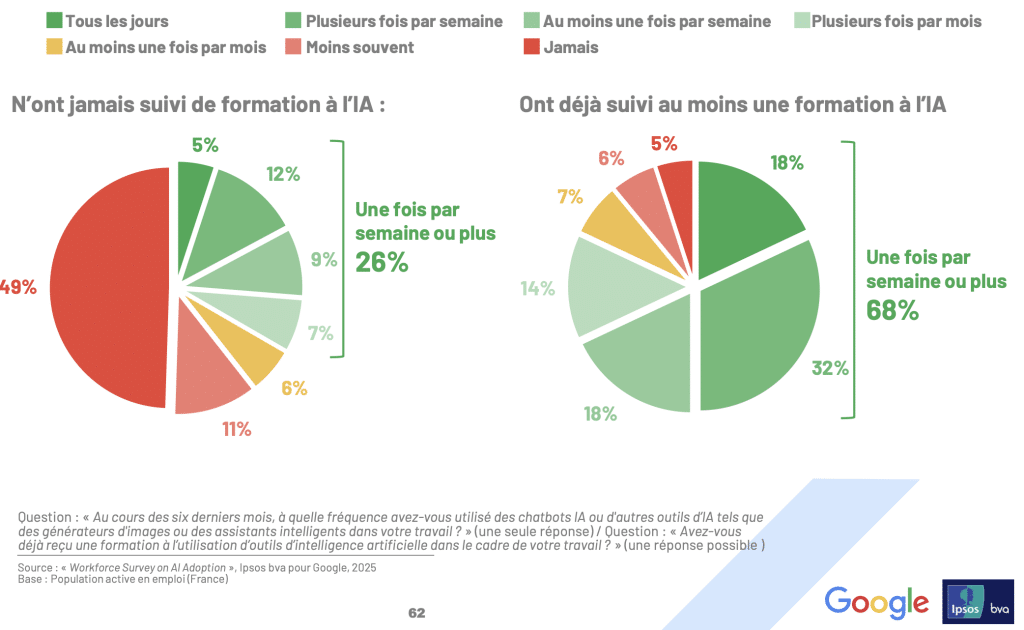
Training also has a direct effect on confidence and applications:
- 76% of those trained identified new use cases thanks to the training.
- 74% gained confidence in using artificial intelligence.
- 74% started using artificial intelligence for new tasks.
- 67% saw a reduction in their fears related to artificial intelligence.
Paradoxically, while 58% state that managers organize artificial intelligence training in their companies, this rate is only 21% among those who received training. Even when these trainings exist, they do not reach all employees or are not seen as sufficiently relevant.
Employees' expectations are clear: 62% want training based on concrete case studies, and 61% want practical training on the use of tools. The demand for theoretical and abstract content is much lower (54%). The issue is not to explain "what artificial intelligence is" but to show "how can I use it in my daily work".
To provide this training, employees trust technology companies (%27) more than employers (%24), training organizations (%22), or educational institutions (%18). Small business managers and freelancers lean more towards technology actors (34% and 32%).
Finally, artificial intelligence skills are becoming an increasingly important hiring criterion: 58% of the French executive segment states that a candidate was hired due to their artificial intelligence skills, which is above the European average (54%). Knowing these tools is no longer just an advantage for employees: it is becoming a prerequisite for employability.



















Comments
(8 Comments)