The giant company from Mountain View has published the integration guide for the Universal Commerce Protocol (UCP). This new open standard allows vendors to offer a direct purchase button in AI search results and Gemini. This is a significant development that will redefine the online shopping experience.
Highlights:
- UCP is an open standard that allows completing a purchase without leaving Google Search (IA mode) or Gemini.
- Vendors need to complete a technical integration, fill out an interest form, and wait for approval.
- The rollout is currently limited to the US and is being done gradually.
- Vendors who adopt the protocol first can gain an advantage over their competitors.
Integrated Payment Process Within IA Search
Until now, a user searching for a product on Google had to click on a link, be redirected to a vendor's site, and then complete the purchase. With the Universal Commerce Protocol, this structure is fundamentally changing. Google's goal is to enable transactions directly within the search interface without leaving the IA experience.
Specifically, eligible vendors can display a payment button on product pages in Google Search's IA mode and Gemini. The protocol makes this seamless by linking product data, user identity, and payment flows.
How the Integration Process Works for Vendors
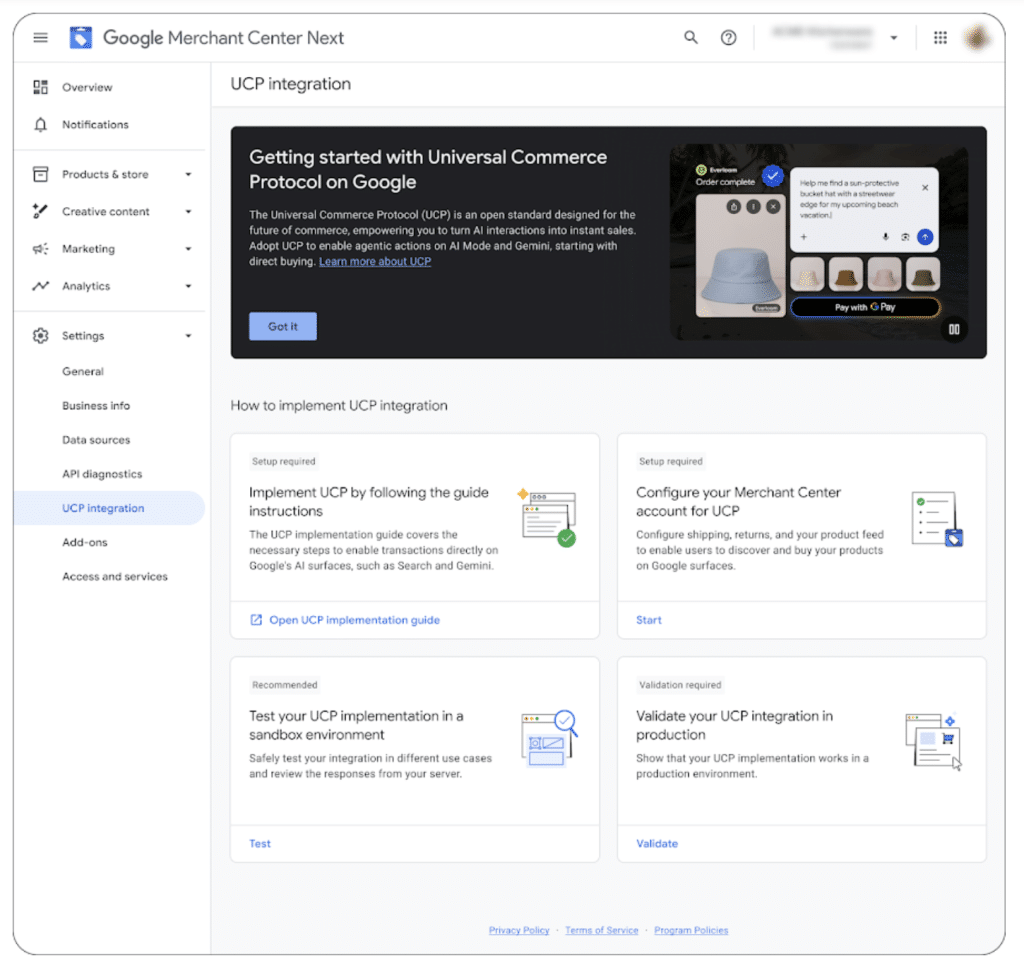
Google has structured the integration process into three distinct phases.
- The first phase is technical: The vendor must implement UCP by following the official developer guide. This phase is mandatory before the other steps.
- The second phase is the application process: The vendor submits an interest form. Google gradually selects participants and sends a notification when access is granted.
- Once accepted, the vendor gains access to an onboarding environment in Google Merchant Center. This area includes a sandbox to test the integration, validate the UCP profile, check identity matching, and local payment APIs. The Merchant Center also informs whether any action is needed on flow attributes, return conditions, or account configuration.
Vendors processing transactions through a third-party platform or service provider are advised to contact them directly to learn about integration timelines for the protocol.
Changes for Advertisers and E-Commerce Vendors
The shift in the conversion point is the most tangible result of this evolution. When users purchase from Google, the metrics they are used to, such as conversion rates or sessions on the site, should be reconsidered without visiting the vendor's site. Attribution and advertising performance optimization will also be affected.
Google is clearly pushing to keep users within its ecosystem; this was a stage it previously missed. For vendors, this means that the data quality and integrity in Merchant Center have become even more strategic: product pages, brand assets, return conditions, everything must be up-to-date and complete.
Currently Limited Distribution, But Should Be Monitored
The distribution is currently limited to the US only and is being provided gradually. In the coming months, a dedicated tab for UCP integration should appear in Merchant Center accounts. French vendors will need to be patient, but it is possible to prepare by anticipating technical requirements and checking the robustness of product data.




























Comments
(3 Comments)