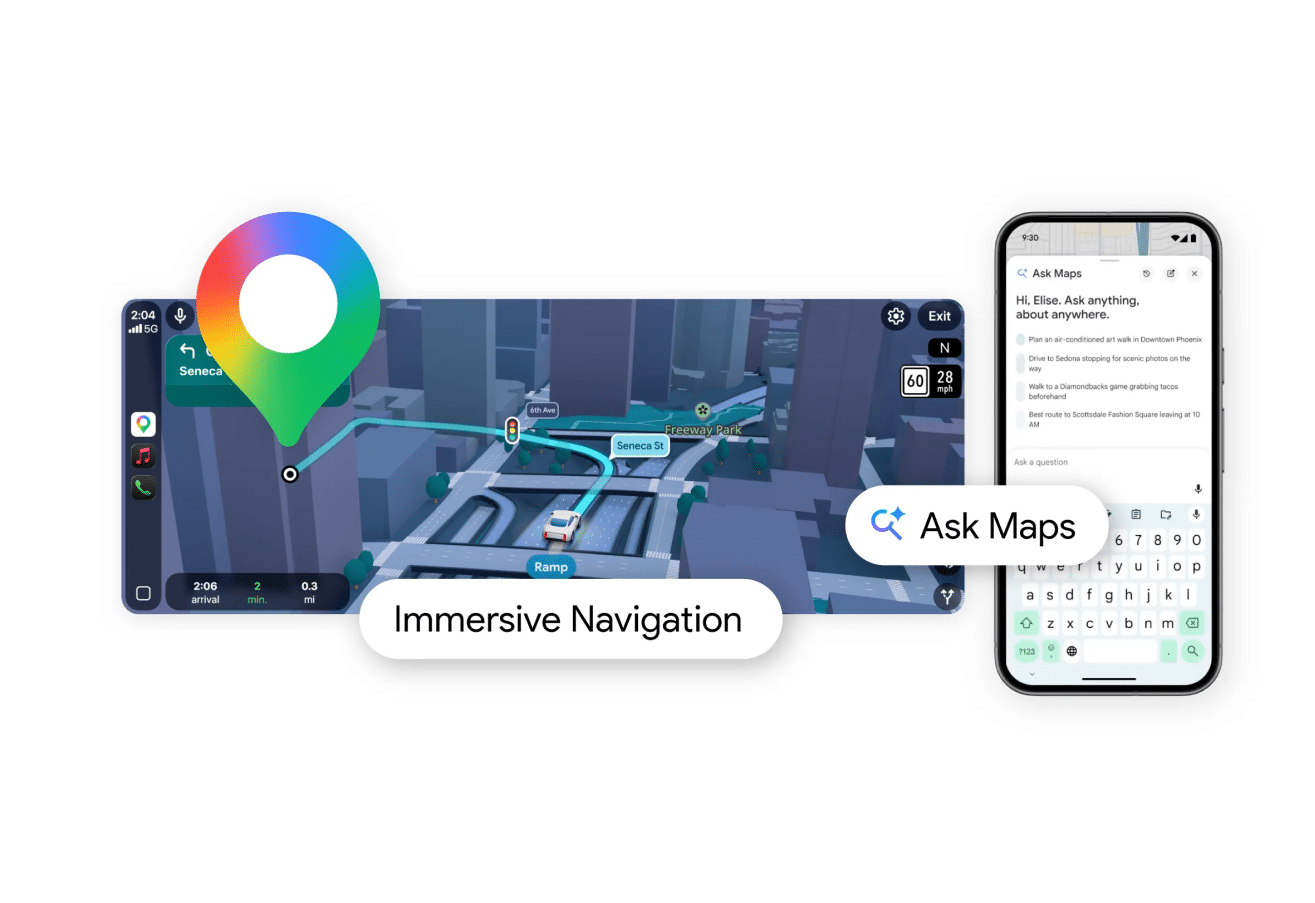
Google Maps is introducing two major innovations by integrating the most powerful Gemini models: Ask Maps, a chat assistant capable of answering complex questions about places, and Immersive Navigation, the biggest redesign of the driving experience in the last decade. All of this has begun to roll out in the US and India.
Highlights:
- Ask Maps allows users to find places by asking questions in natural language, with over 300 million place data and comments from 500 million contributors.
- Responses are personalized based on the user's history (saved places, dietary preferences, etc.) and provide direct actions: reservations, routes, sharing.
- Immersive Navigation offers a rich 3D view of the road, smart zooms for complex turns, and real-time event alerts thanks to Gemini's analysis of Street View images.
- Both features are currently available in the US and India on Android and iOS, with a gradual expansion planned in the coming months.
Ask Maps: Ask a real question, get a real answer
Until now, Google Maps was responding to simple queries: finding a restaurant, calculating a route. Ask Maps marks a new phase for Google. Now, questions like "My phone is about to die, where can I charge it without waiting in line for coffee?" or "Is there a lit tennis court this evening?" can be asked. The old Maps could not process such queries directly.
This feature is based on Google's Gemini models and relies on a database continuously fed by over 300 million place data and 500 million contributors. The result: contextual answers and a personalized map to visualize available options.
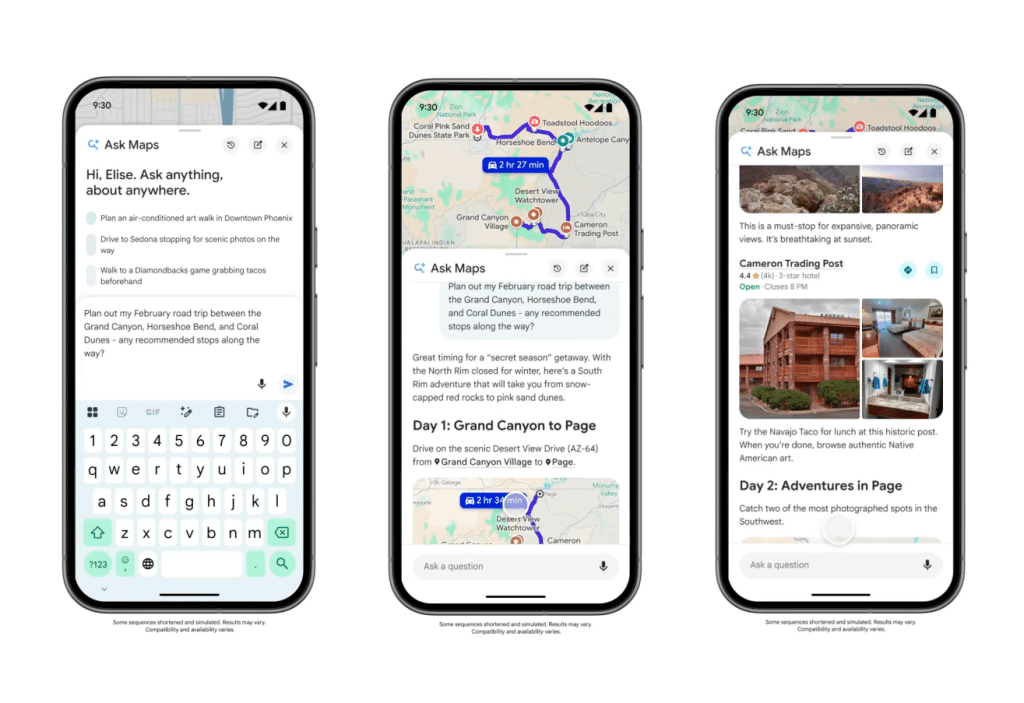
The personalization aspect is of central importance. Ask Maps narrows down its suggestions by taking into account the user's saved preferences, favorite restaurants, dietary habits, and saved places. A concrete example given by Google: When you say "At 7:00 PM, I’m looking for a place for four with my friends coming from Midtown East.", Ask Maps already knows you prefer vegan restaurants and suggests addresses accordingly.
Once the place is determined, the action starts immediately: table reservation, adding to the list, sharing with friends, or starting navigation, all from the same interface. The rollout is currently starting in the US and India on Android and iOS, with a desktop version to be announced soon.
Immersive Navigation: A driving experience reinvented with 3D
On the navigation side, Google Maps is presenting the most ambitious redesign of the last decade. This feature, called Immersive Navigation, transforms the map view into a dynamic 3D representation that faithfully reflects the real environment: buildings, bridges, terrains, road lanes, traffic lights, pedestrian crossings.
This spatial representation is made possible by Gemini's real-time analysis of Street View images and aerial photographs. The app performs smart zooms before each precise maneuver, making buildings transparent to better see upcoming intersections, and provides voice instructions more naturally, like a passenger: "Pass this exit and take the next exit for Illinois 43 South."
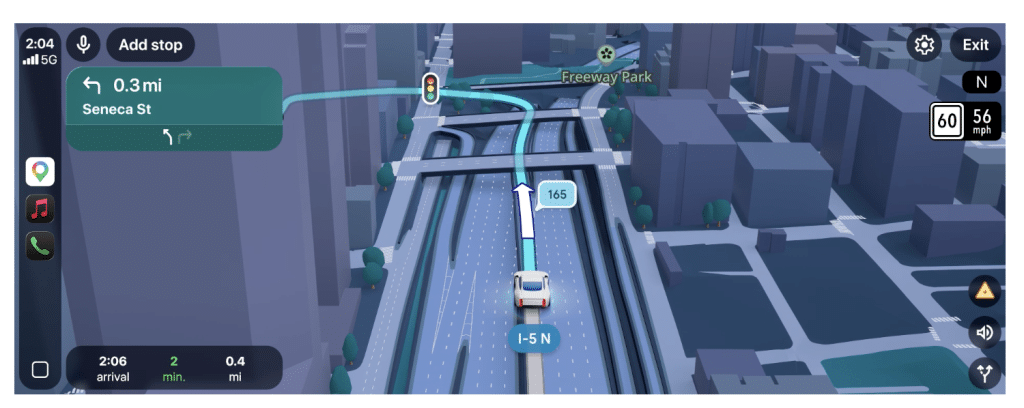
The update also enhances the management of alternative routes. Every second, Maps receives over 5 million traffic updates worldwide. The app now clearly presents compromises between options: a longer journey with no traffic or a paid fast route. Real-time reported events, constructions, and accidents are provided by contributions from 10 million drivers daily and are directly shown on the map.
Finally, as you approach your destination, Maps guides you right to the door: it provides information such as a preview of the building's Street View, parking suggestions, the exact location of the entrance, and which street to stop on. Immersive Navigation will be gradually rolled out in the US today and will be available on iOS, Android, CarPlay, Android Auto, and integrated vehicles with Google.


































Comments
(6 Comments)