
Google has introduced a new user-agent called "Google-Agent," designed for users to navigate the web and perform actions upon request. This is a strong indication of the empowerment of autonomous agents within the Google ecosystem.
Key Points:
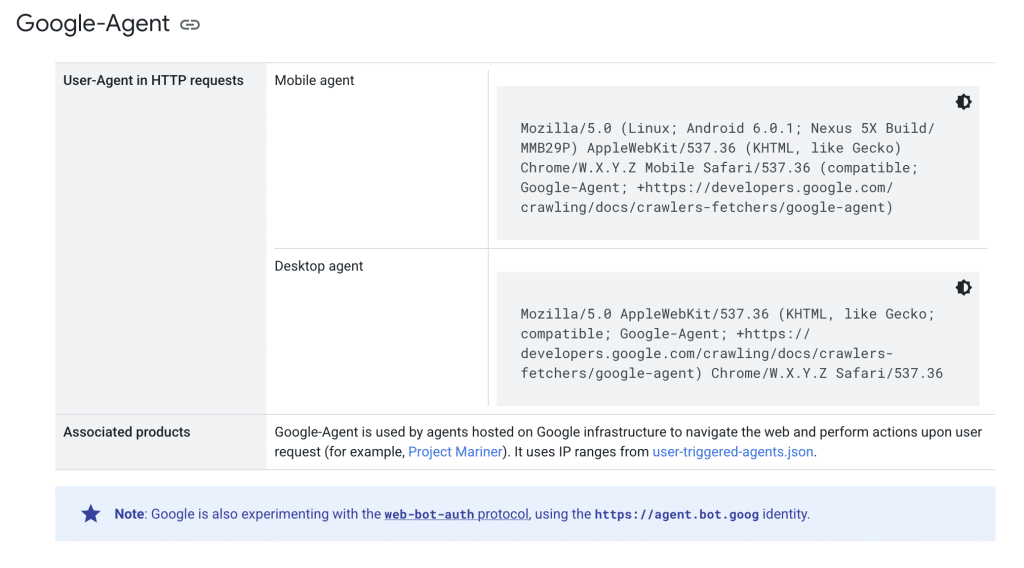
- Google has added a new user-agent named "Google-Agent," which falls into the category of "user-triggered fetchers."
- This is used by agents hosted on Google infrastructure to navigate the web and perform actions at the request of users.
- Project Mariner is mentioned as a concrete use case.
- Google is also testing the web-bot-auth protocol with the identity https://agent.bot.goog.
As of March 23, 2026, Google officially announced the arrival of a new user-agent: Google-Agent. This joins the list of "user-triggered fetchers," which are robots triggered not by the search engine but directly by a user action.
Specifically, when you request a Google agent to perform a task on the web, this user-agent introduces itself to the servers of the visited sites. Google states that the rollout will occur gradually over the next few weeks.
A User-Agent Associated with Google’s IA Agents
The Google-Agent user-agent is directly associated with agents hosted on Google infrastructure. These agents have the ability to navigate web pages and perform actions like a human user, but they do so automatically.
Google showcases Project Mariner as a use case. To remind, Project Mariner is Google’s IA agent that can control a browser to perform tasks on behalf of the user: filling out forms, searching, interacting with web interfaces, etc.
Technically, the Google-Agent uses IP ranges referenced in the user-triggered-agents.json file, allowing site administrators and developers to identify and filter these requests when necessary.
Web-bot-auth Protocol Emerges
Along with this new user-agent, Google indicates that it is testing a new standard designed to authenticate bots on the web called web-bot-auth. Google is using the identity https://agent.bot.goog for this.
This protocol aims to provide greater transparency in interactions between automated agents and websites: instead of a simple user-agent that anyone can mimic, web-bot-auth will allow verification of whether a bot is indeed what it claims to be. This is an important issue for publishers who want to control access to their content as the number of IA agents increases.


















Comments
(3 Comments)